
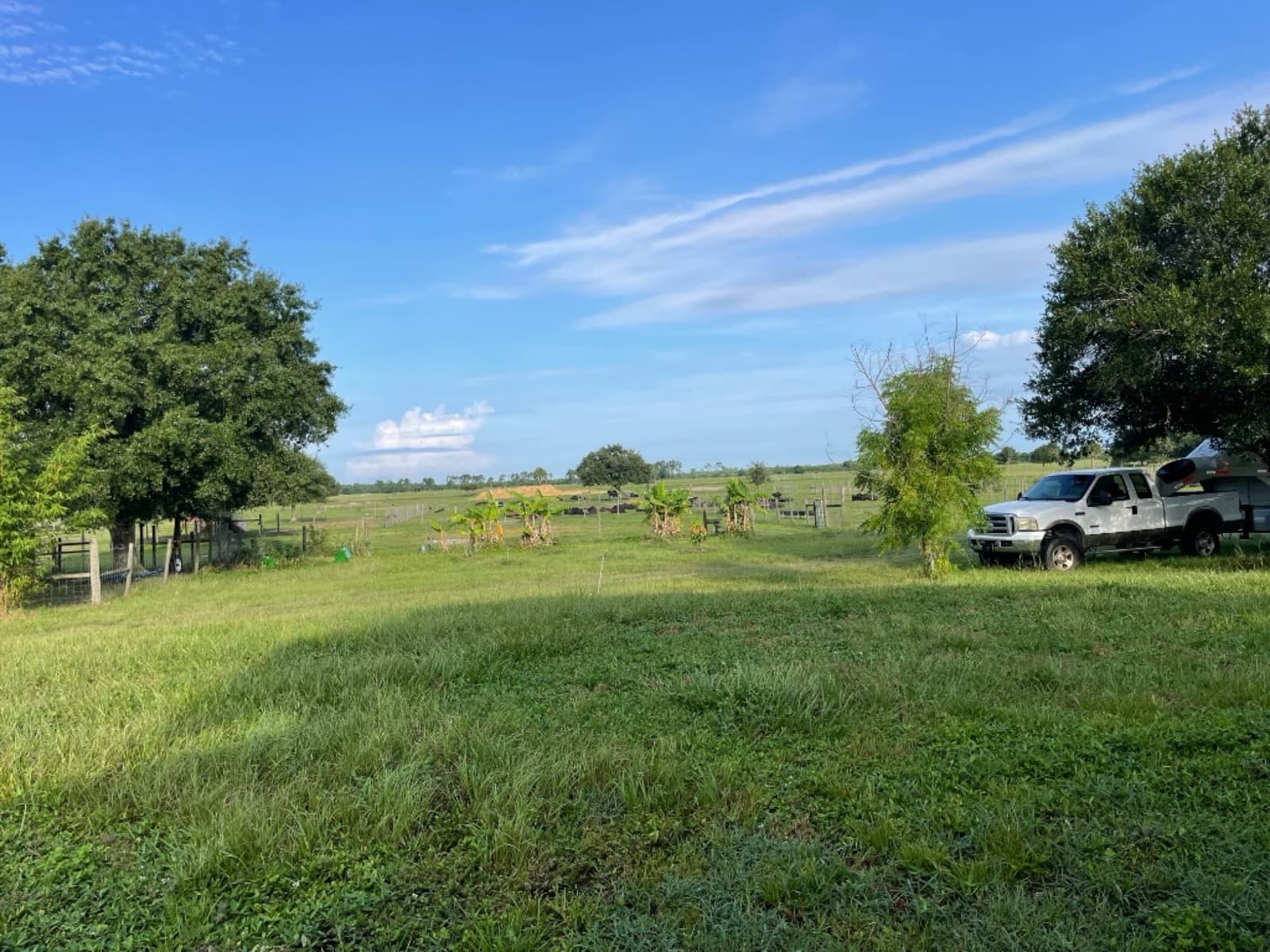
Punta Wagyu Ranch · Charlotte County, Florida
Fullblood Wagyu freezer beef at introductory $10/lb hanging
Freezer beef shares from an eighth to the whole animal — cattle we raise ourselves in Southwest Florida — 600+ days on grain (or 30+ months old), AWA-registered, no implants, no routine antibiotics. Healthier choice at bulk discount.
Introductory rates on the shares open now — $10/lb hanging for a quarter, $9.75 for a half, $9.50 for the whole animal, $11 for an eighth. The standard rate on later animals is $14/lb hanging. Shares from other fullblood ranches run about $24–$28 per packaged pound; ours works out to about $17–$19, processing included.
About 446 lbs left — up to seven eighths share
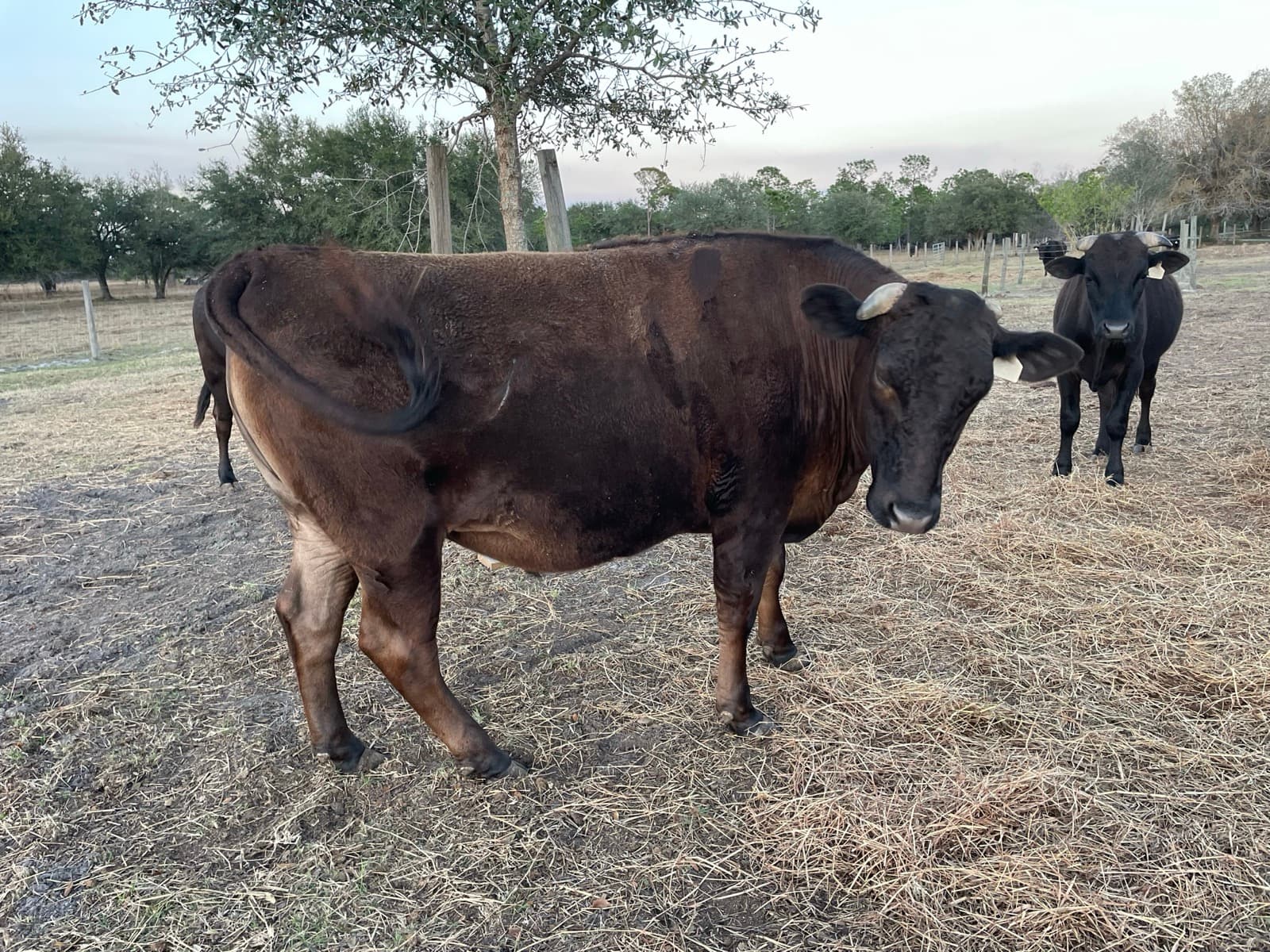
- Intro $10/lb
- hanging weight · about $16.50–$19.00 packaged
- 600+ days
- on grain · or 30+ months old — not a feedlot push
- Fullblood
- AWA-registered, 100% Japanese
- Southwest Florida
- raised and picked up here
Pricing
Introductory $10/lb hanging weight
At our introductory rates, a quarter works out to about $17.50/lb in your freezer and the whole animal about $16.50/lb, processing included. Half shares are $9.75/lb hanging; the whole is $9.50/lb. An eighth is $11/lb. The invoice is always rate × your share of the carcass before cutting.
Bought a cut at a time, the same fullblood beef runs $69 for a ribeye alone. A share averages the loin and rib steaks, the quick-cook and braising cuts, and the ground into one bill — typically about a quarter less than fullblood bought by the cut, not crossbred Wagyu at a local counter. Every pound comes off the same marbled animal.
Introductory rates on the shares open now — $10/lb hanging for a quarter, $9.75 for a half, $9.50 for the whole animal, $11 for an eighth. The standard rate on later animals is $14/lb hanging. Shares from other fullblood ranches run about $24–$28 per packaged pound; ours works out to about $17–$19, processing included.
Quarter share
$10/lb hanging
$17.50/lb packaged · save ~$1,671 (43%)
Bigger shares go as low as $9.50/lb hanging.
Quarter share
A solid household share. Plan ~3.7 cu ft of freezer.
$10/lb hangingintro
$2,229estimated all-in
Same cuts bought individually $3,900
Save ~$1,671 (43%)
- Est. take-home
- ~128 lbs
- Ground beef
- ~41 lbs
- Quick-cook & braise
- ~38 lbs
- Loin & rib steaks
- ~27 lbs
- Ribs, stew, bones
- ~22 lbs
- About /lb packaged
- $17.50/lb
- Processing (at cost)
- $339
- Deposit to reserve
- $250
The Herd
Our fullblood herd
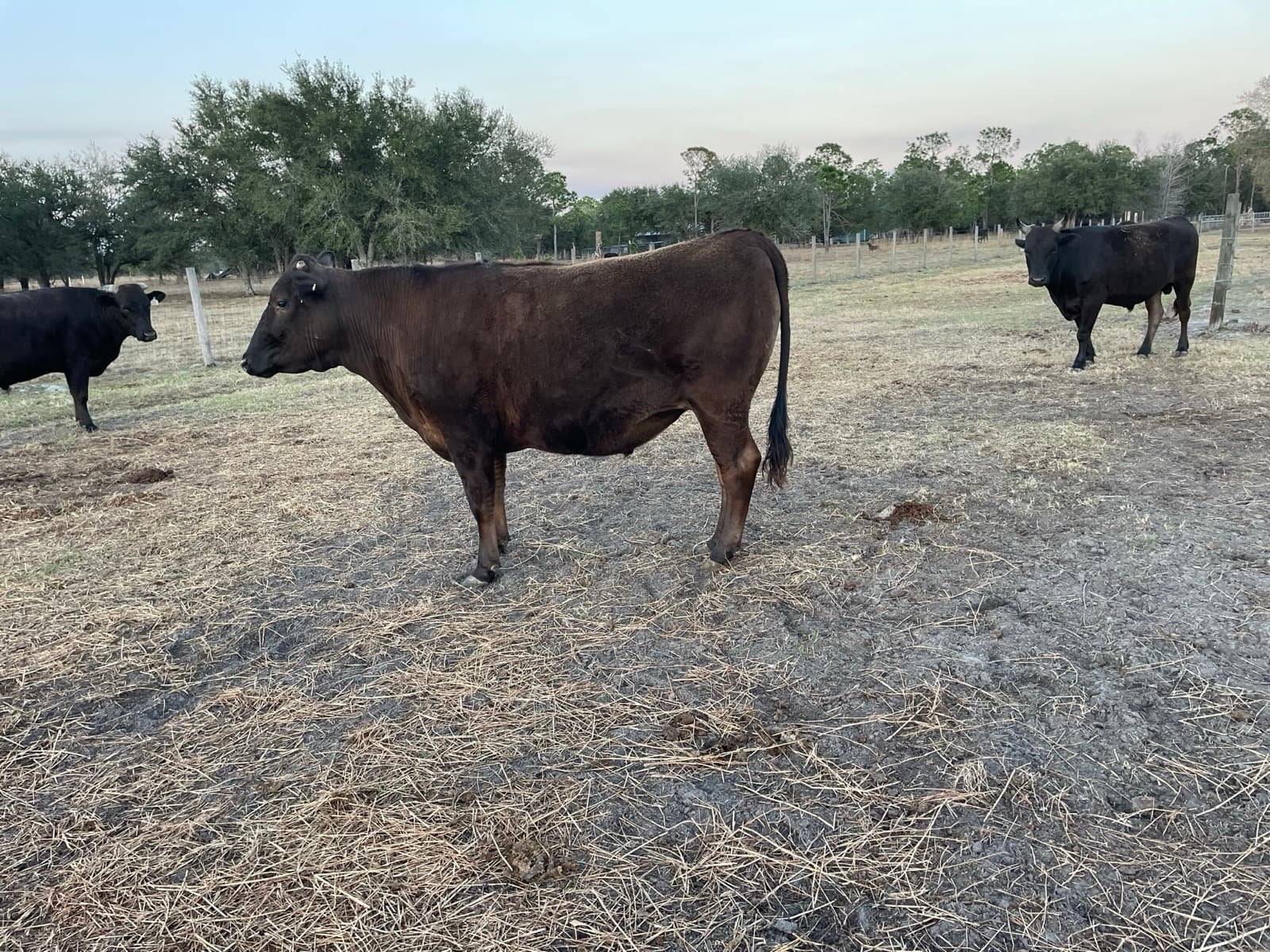
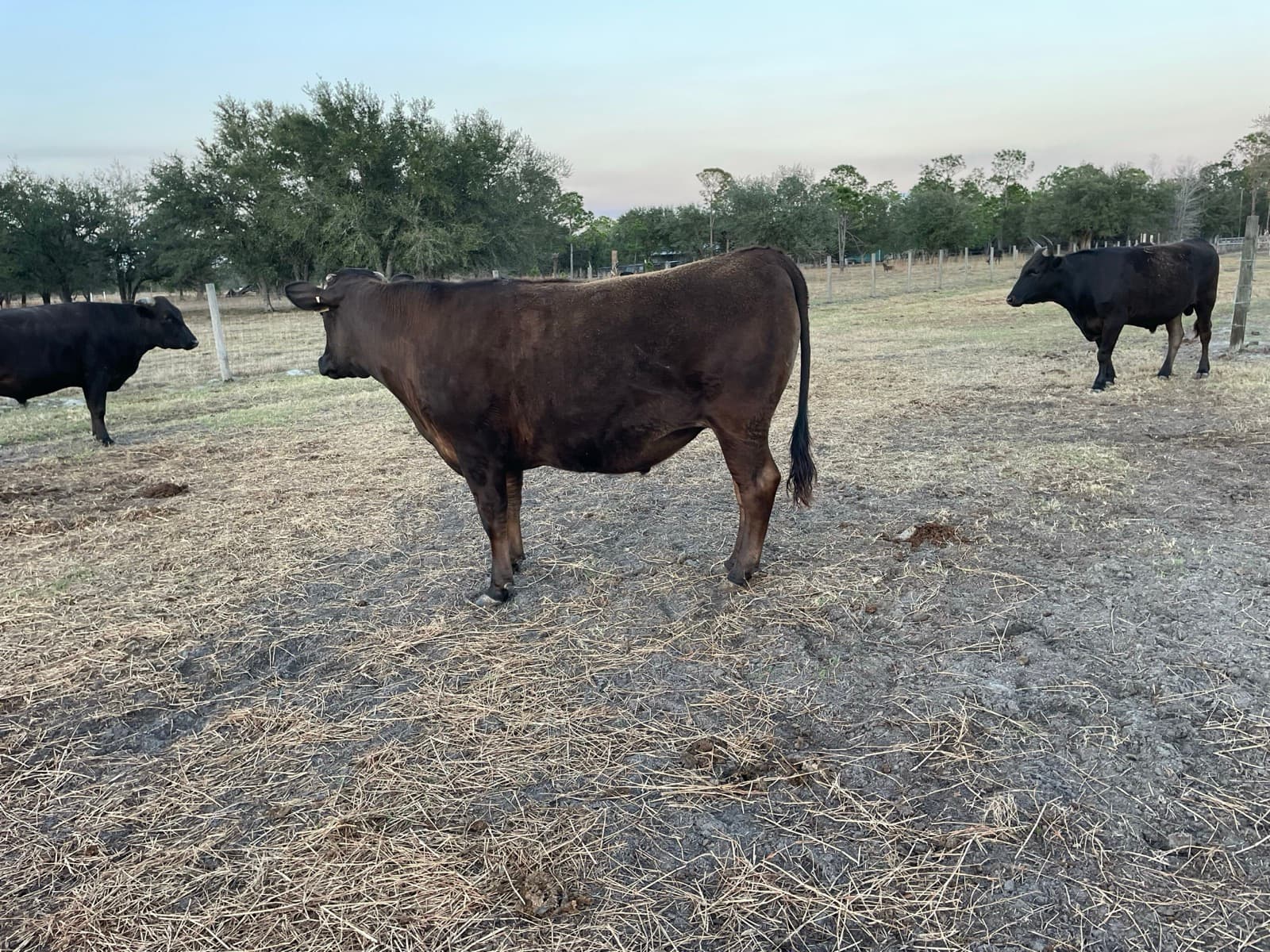
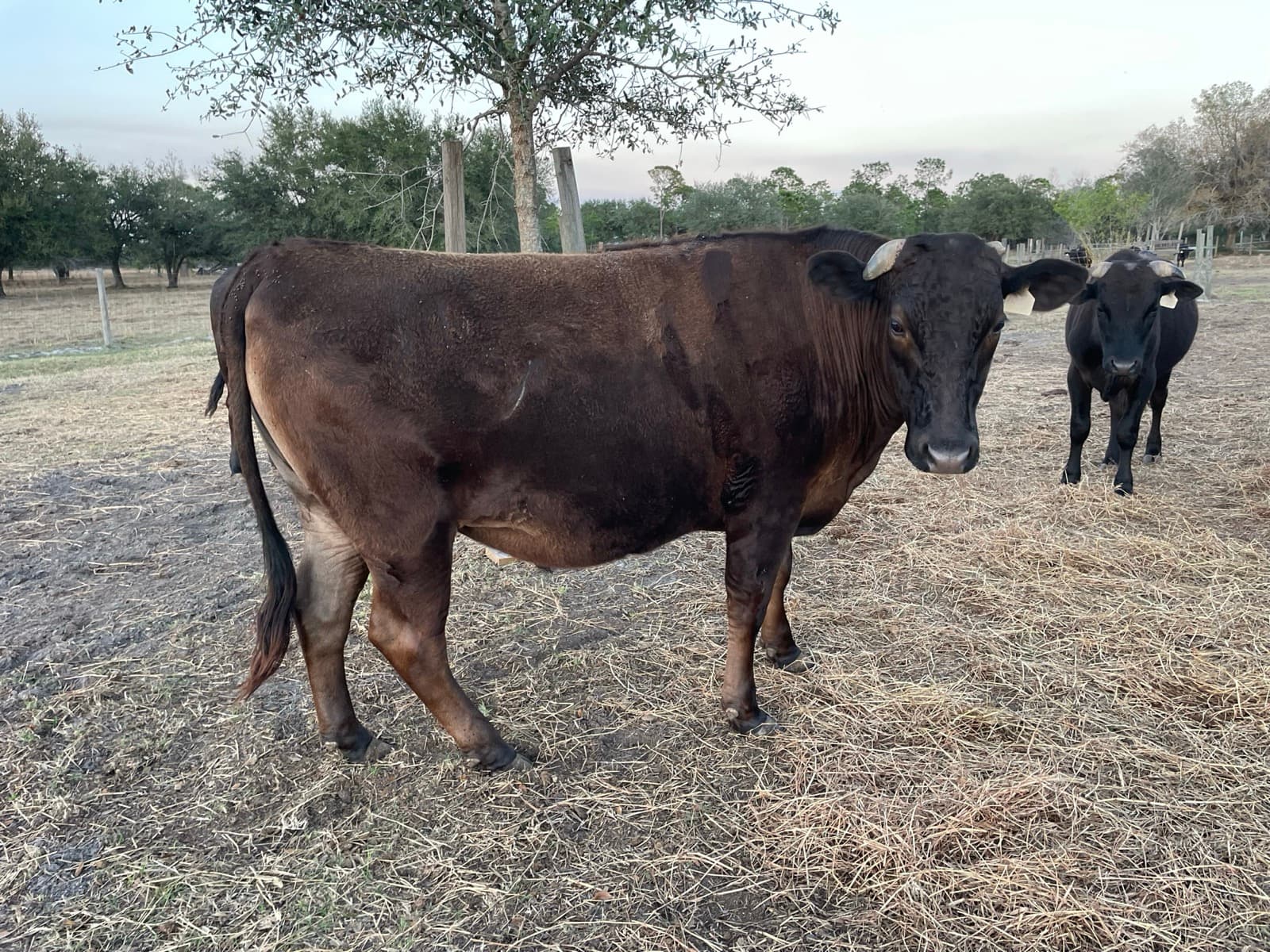
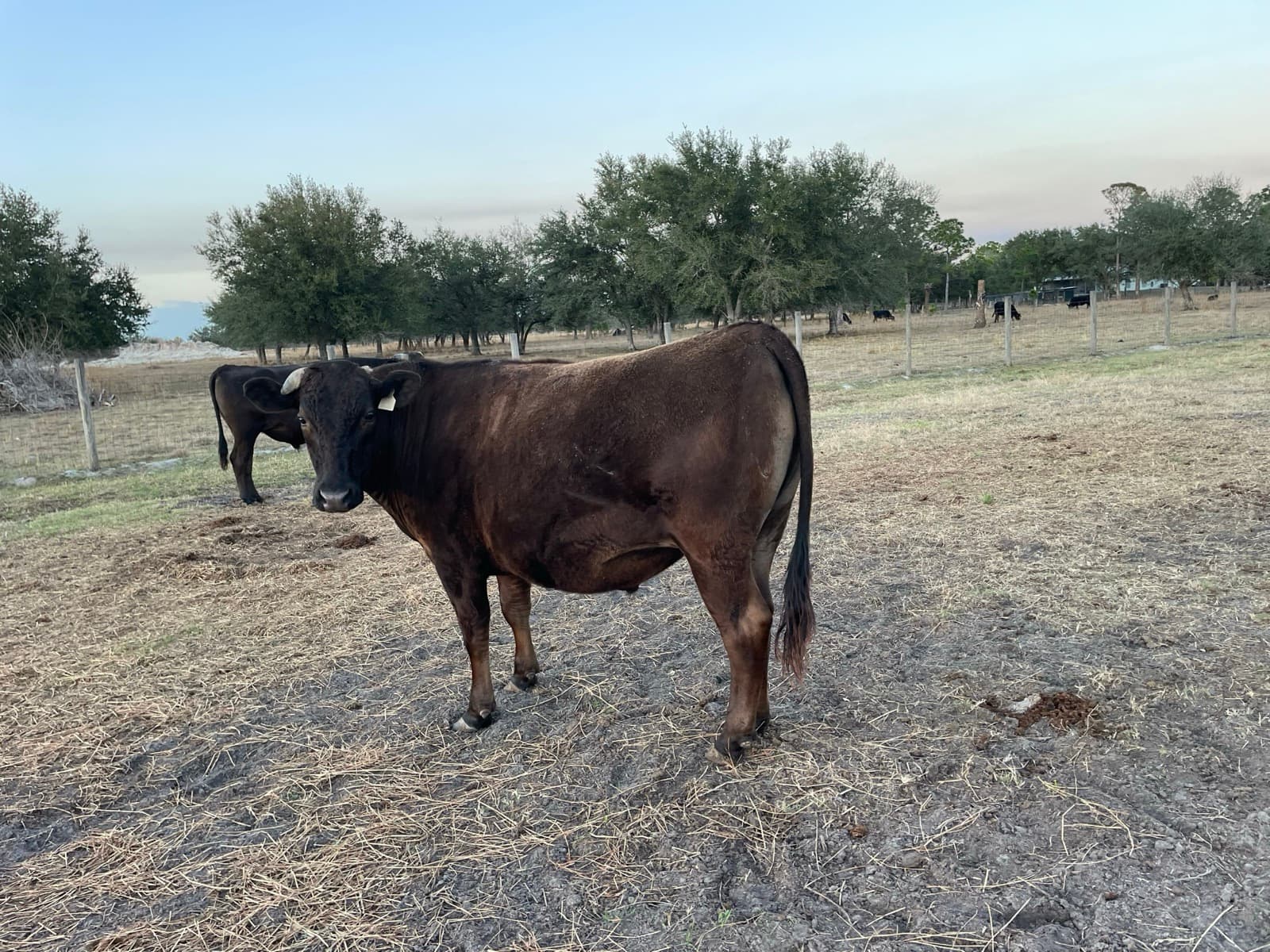
Every animal we offer is registered fullblood Japanese Wagyu — 100% Japanese genetics. We do not push them onto a feedlot clock: they stay on grain 600+ days, or until they are 30+ months old, out on our Charlotte County pasture. The AWA registration number on the animal at the head of the queue is the guarantee; that is what you can check against a third party.
Most beef sold as “Wagyu” in the US is a cross with no minimum percentage on the label. Ours is the real thing — one animal, one registration, marbling that runs through the everyday cuts in your freezer, not only the steaks.
Genetics
Verified fullblood Japanese Wagyu
Every animal we offer is registered with the American Wagyu Association as a fullblood Japanese Wagyu — 100% Japanese genetics, not crossbred “Wagyu-style” beef. The registration number on the animal you reserve is what you can check.
That number confirms pedigree and breed classification. Owner of record is AWA member #3602 — publicly verifiable. These genetics produce the marbling and flavor profile associated with premium Japanese Wagyu.
We do not push a feedlot finish. Cattle stay on grain 600+ days, or until they are 30+ months old — most US beef sold as “Wagyu” is finished closer to 200–400 days. That long finish is why the marbling claim holds.
Each buyer receives documentation of their share of the live animal ownership before slaughter, as required for custom-exempt processing.
The certificate below is from our first harvest — see the full record for FB94946 — pedigree, measured weights, and what we deliberately do not claim.
Breed percentage
What “Wagyu” on a label does not tell you
Wagyu is not one thing. Cattle registries grade it by how much of the pedigree traces back to Japan, and the same five letters go on a package at every rung of that ladder. Knowing which rung you are buying is most of what separates a fair price from a bad one.
The ladder, as the registries define it
Swipe the table →
| Registry tier | Wagyu genetics | What it is |
|---|---|---|
| F1 | 50% | A fullblood Wagyu bull over a cow of another breed, most often Angus. This is what the majority of beef sold as Wagyu in an American store or restaurant is. |
| F2 | 75% | An F1 daughter bred back to a fullblood Wagyu bull. |
| F3 | 87.5% | A third generation bred back to fullblood. |
| Purebred (F4) | 93.75% | A fourth generation bred back to fullblood. It registers as purebred — and it stays purebred however many generations follow, because another breed is still in the pedigree. |
| Fullblood (Japanese Black)Ours | 100% | Every ancestor traces to the cattle Japan exported, with no other breed anywhere in the pedigree. This is what we raise and what the registration number on your animal records. Note that this rung describes a registered breed, not just Japanese ancestry: the American Wagyu Association keeps Japanese Black and Akaushi (Japanese Red) as separate fullblood registers, and a Black crossed with a Red registers as Composite, not fullblood. |
Tier names and percentages are the breed-registry definitions used by the American and Australian Wagyu associations. They describe how cattle are classified, not how any particular seller's beef was produced.
- Purebred does not mean one hundred percent
- In every other breed of cattle it does, which is exactly why the word catches people out here. Japan closed live exports in the late 1990s and left breeders elsewhere with very few fullblood animals to work from, so the herds outside Japan were bred up out of other breeds instead. Purebred is the name for where that gets you. An animal that starts as a cross can be bred toward fullblood for generations without ever arriving.
- DNA verification proves parentage, not percentage
- Registering a fullblood and registering a purebred both require DNA parent verification. So a seller telling you their beef is DNA-verified has told you the pedigree is genuine and nothing at all about which rung of this ladder the animal stands on. Only the classification recorded against that individual animal answers it.
- The word on the label carries no minimum
- No Wagyu percentage is required behind the term on an American label. A voluntary USDA-verified program now exists, but taking part is optional, so most beef sold as Wagyu is telling you only that some Wagyu appears in the pedigree somewhere.
- Fullblood, but not the same breed
- Wagyu is four breeds, and the ones outside Japan are Japanese Black (Kuroge) and Akaushi, also called Japanese Red or Japanese Brown. Both can be registered fullblood, so a hundred percent does not on its own tell you which you are buying. They are separate registers — a Black crossed with a Red is registered Composite, not fullblood — and they were selected for different things. Japanese Black is the marbling breed behind the Tajima lines and most of Japan's beef herd. Akaushi descends from Kumamoto cattle crossed with Simmental and was bred for pasture adaptation and lean muscle rather than extreme marbling. So when a seller says fullblood, the next question is which breed register, and what it was selected to do.
Ask any seller which classification is recorded against the individual animal you would be buying from, and for its registration number. Fullblood, purebred, or a percentage — whoever has it will tell you, and whoever does not, cannot. Ours is fullblood, registered with the American Wagyu Association under member #3602 — the certificate and measured weights for our first harvest are on the record for FB94946.
On your plate
What the marbling actually gets you
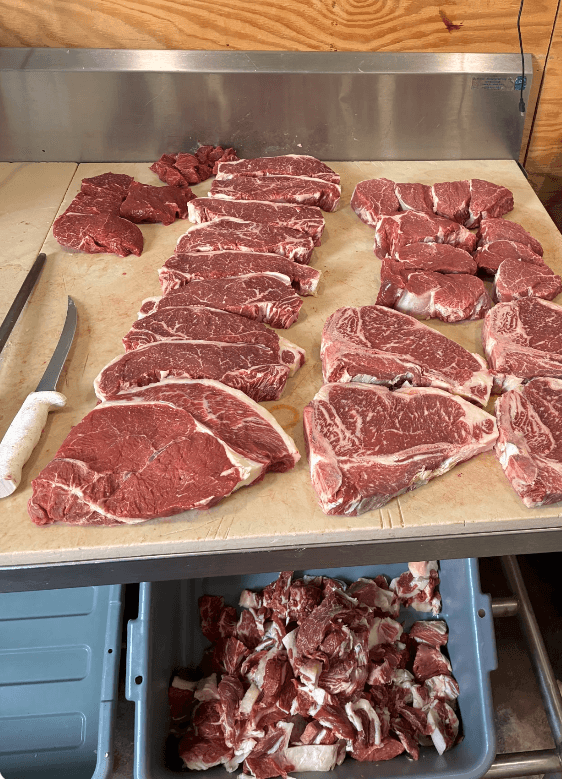
A quarter share is roughly 128 lbs of beef. Only about 27 lbs of that is loin and rib steak — 41 lbs is ground beef, 38 lbs is quick-cook and braising cuts, and 22 lbs is short ribs, soup bones and the rest. That is the point: every cut here comes off the same marbled carcass. The long finish — 600+ days on grain, or 30+ months old — is what puts fat through the everyday cuts, not only the ribeye.
- The upgrade is in the whole freezer, not just the steaks
- With commodity beef only the premium cuts justify a premium, and the chuck is just chuck — so a freezer full of it is mostly ordinary. Fullblood marbling runs through the everyday cuts too, which is where nearly all of that poundage sits.
- USDA Prime is the top of a short ruler
- American grading stops at Prime, which lands around the middle of the twelve-point scale Japan uses for marbling. Several grades sit above anything the USDA has a word for. Someone who knows Prime from the supermarket case has only ever seen the lower half of the range.
- Richer, not beefier
- Worth saying plainly, because the expectation trips people up: this is not a more intense version of supermarket steak. The fat is milder and sweeter, with far less of the tallowy note commodity fat carries, and because it melts near body temperature it coats the palate and the finish runs long.
- It is forgiving
- Fat inside the muscle bastes the meat from within as it renders, so a tender result does not depend on sous-vide or a reverse sear. For a home cook that is worth more than any tasting note.
- The long finish is a mechanism, not a spec
- Time on grain is what deposits marbling in the first place, and it pushes flavor toward the sweeter, nuttier end while suppressing grassy notes. Commodity beef is finished in a fraction of the time.
And what it is not
- It is not leaner or lower in calories than commodity beef. It is the opposite, and that is the entire point.
- Portions run smaller — a modest steak satisfies where a big commodity ribeye would, which stretches a share further than the poundage suggests.
- It wants lower heat and thinner cuts, because a high-fat steak flares on a hot grill.
- It is not the right beef for every job. For a big rare grilled steak, or if you love dry-aged funk, well-aged Angus is the better choice.
How they are raised
No implants, no routine antibiotics
Feed and health records are open to any buyer who wants to read them, and you can come meet the animal before you commit a dollar.
- No growth hormones or implants
- None of our cattle carry a growth implant. Nothing is used to push weight gain onto a feedlot clock — we let them stay on grain 600+ days, or until they are 30+ months old, rather than forcing a finish in a few months.
- No antibiotics in feed, none routine
- Nothing preventative, and nothing mixed into feed. If an animal gets sick we treat it, because the alternative is letting it suffer to protect a sales line — and we will tell you if that happened. The feed and health record is open to any buyer who asks.
- No ractopamine or beta-agonists
- No feed additives used to add lean mass in the final weeks. On a Wagyu the entire point is fat inside the muscle, so the class of drug that works against it has no place here.
- Born here, on pasture daily
- Born on this homestead and out on open pasture every day, handled by the same people since they were calves. No feedlot or sale barn means no auction environment and no mixing with unfamiliar cattle. Familiar people and a predictable routine help keep them calm.
- No long-haul transport
- Processed at a licensed custom-exempt facility a short drive from the pasture rather than trucked across state lines. Stress causes muscles to use stored energy, which can affect the beef's color, tenderness and flavor. Familiar handlers and a short trip help reduce that risk.
- One animal, one registration number
- Everything in your freezer comes from one AWA-registered animal and nothing else. Supermarket ground beef is typically combined from many carcasses; yours traces to a registration number you can check, and an animal you are welcome to come out and look at.
Against what else is in the case
Swipe the table →
| Attribute | Our herd | Supermarket “Wagyu” | Commodity beef |
|---|---|---|---|
| Genetics | 100% fullblood, AWA-registered | Typically 50% Wagyu crossed to Angus | Angus or continental cross |
| Days on grain | 600+ (or 30+ mo) | Typically 200–400 | Typically a few months |
| Growth implants | None, ever | Commonly used | Commonly used |
| Antibiotics | None in feed, none routine | Commonly used | Commonly used |
| Feed additives | None | Commonly used | Commonly used |
| How they lived | Born here, open pasture daily | Typically feedlot-finished | Typically feedlot-finished |
| Transport to harvest | Short local haul | Typically multi-state | Typically multi-state |
| Traceability | One animal, one registration number | Not traceable to an animal | Ground beef typically combined from many carcasses |
| Can you meet the animal | Saturdays 9–12 ET, by appointment — free tasting | No | No |
The right-hand columns describe how beef in those categories is typically produced and sold in the United States. They are not claims about any particular store, brand, or product.
The last row is the one no online seller can match. Saturdays 9:00 a.m.–12:00 p.m. Eastern, by appointment — walk the pasture, meet the animal, and taste Wagyu from our first harvest. The tasting is free. Call (941) 888-4508 to book — more of the husbandry reasoning is on how we raise them.
How It Works
From pasture to your freezer
Three steps. Household freezer beef from a registered fullblood animal — not a butcher-case shopping trip.
Put down a deposit
Choose an eighth ($150) or a quarter ($250). The deposit holds your place and applies to the final balance — it is not an extra fee.
We finish and harvest
We schedule the animal with the processor. If harvest has not happened within two months of your deposit, you are refunded in full.
One invoice, then pickup
After cutting, you get one bill for beef plus processing at cost. Pay by cash, certified check, or money order, then pick up frozen beef at the ranch (typically 10–21 days after harvest). Local delivery on request.
Ranch visit
Come taste it first
Saturdays 9:00 a.m.–12:00 p.m. Eastern, by appointment — walk the pasture, meet the animal, and taste Wagyu from our first harvest. The tasting is free.
Call or text (941) 888-4508 to book — no deposit required for the visit.
FAQ
Common questions
Why buy expensive Wagyu from us — is it a healthier choice?
Yes on the fat composition, and yes on how we raise it — that is what the premium is for. Fullblood Wagyu's health benefits start with more monounsaturated fat than ordinary beef, including oleic acid (the same family of fat people know from olive oil), plus more omega-3 and omega-6 than commodity beef. A large share of the saturated fat is stearic acid, and because the fat is more unsaturated it melts near body temperature, so it digests softer than heavy conventional tallow. You also get dense protein with bioavailable heme iron, zinc, selenium, and B-vitamins — especially B12. The flavor is rich enough that a small portion (about 2–4 ounces) fills you where a supermarket steak would not, and the beef renders its own fat in the pan, so you rarely need butter or oil. That is the breed. From us you also get fullblood genetics against an individual AWA registration number, no growth implants, no routine antibiotics, and the bulk share rate instead of retail cut-by-cut pricing — healthier choice at freezer scale, not a one-night steak.
How much freezer space do I need?
Plan about 1 cubic foot for every 35 lbs of packaged beef. An eighth needs ~1.8 cu ft — clear a shelf in the freezer above your refrigerator and you already have it, no second appliance required. A quarter needs ~3.7 cu ft, which is a small chest freezer. A half needs ~7.3 cu ft and a whole ~14.6 cu ft, so those want a dedicated one. Wrapped packages stack unevenly, which is why the rule is that conservative.
What does the deposit cover?
Eighth share: $150 deposit. Quarter share: $250 deposit. Half share: $500 deposit. Whole share: $1,000 deposit. Your deposit applies to the final balance. It becomes non-refundable once the harvest date for your animal is scheduled. If the ranch cancels, you are refunded in full. If harvest has not happened within two months of your deposit, you are refunded in full — that guarantee overrides forfeiture.
Should I start with an eighth or a quarter?
Start with an eighth if you are new to freezer beef or short on space — about 64 lbs, roughly two months of beef for a couple, deposit $150. Step up to a quarter (128 lbs, deposit $250) when you know the household will use it. Same animal, same cut sheet — only the size changes.
More on what you are buying, cooking it, hurricane season, ranch visits, and pickup — see the full FAQ.
Reserve
Reserve your freezer share
Deposit $150 for an eighth or $250 for a quarter. It applies to your final balance. Packaged beef comes back to the ranch for pickup after harvest (current animal: AWA FB94943).
About 446 lbs left — up to seven eighths share
Not ready to commit?
Saturdays 9:00 a.m.–12:00 p.m. Eastern, by appointment — walk the pasture, meet the animal, and taste Wagyu from our first harvest. The tasting is free. Call or text (941) 888-4508 to book — no deposit required. See ranch visit details.