Punta Wagyu Ranch

Steer FB94946PGWR MR KIKUHANA 105L1

FB94946 is a registered fullblood Japanese Wagyu steer, born on this homestead in Punta Gorda, FL and out on open pasture every day since. He is registered with the American Wagyu Association as PGWR MR KIKUHANA 105L1, registration number FB94946, owner of record AWA member #3602. Fullblood means 100% Japanese genetics with no crossbreeding — not “American Wagyu,” which is a Wagyu cross, and not “Wagyu-style.” He is 3 years 200 days old, weighs about 1,330 lbs live, and has finished more than 500 consecutive days on grain.

Shares of him are sold as share of the live animals for household use, not resale, priced per lb hanging weight with processing included on one bill. Every figure on this page is either printed on his registration certificate or measurable on the ranch, and you are welcome to come check both.

Share status

2 quarters available

Shares of FB94946 are open now — a half is two quarters. A deposit holds one; the balance is invoiced per lb hanging weight once the processor reports.

Reserve a share

Check it yourself

“Wagyu” is not a protected term on an American label. A steak can be sold as Wagyu with a single Wagyu grandparent, or with none at all if the seller is careless, and nothing about the word obliges anyone to prove it. That is why the number matters more than the adjective: a registration number is a claim that can be failed.

There are three ways to check this one, in rising order of effort:

  1. Read the certificate below. It carries the registration number, the registered name and the pedigree behind them.
  2. Take registration FB94946 and member #3602 to the American Wagyu Association. Both are the association’s records, not ours, and we have no way to edit them.
  3. Come and stand next to him. He is alive, he is twenty minutes from Punta Gorda, and the feed and health records are open to anyone considering a share. Arrange a visit — there is no obligation and nothing to sign.

American Wagyu Association registration certificate FB94946 for fullblood Wagyu steer PGWR MR KIKUHANA 105L1

American Wagyu Association registration certificate FB94946 for fullblood Wagyu steer PGWR MR KIKUHANA 105L1

Press Escape or click the dimmed area to close

AWA Registration #FB94946 PGWR MR KIKUHANA 105L1

The record

Hanging weight is an estimate until the processor reports it, and it is deliberately rounded down from what we measure. Everything else here is fixed.

Ranch tag
FB94946
Registered name
PGWR MR KIKUHANA 105L1
AWA registration number
FB94946
AWA member of record
#3602
Breed classification
Fullblood Japanese Wagyu — 100% Japanese genetics
Sex
Steer, castrated 2023-12-22
Born
Punta Gorda, FL — on this ranch
Age
3 years 200 days
Live weight
1,330 lbs
Days on grain
500+ consecutive days
Estimated hanging weight
840 lbs

Why 500+ days matters

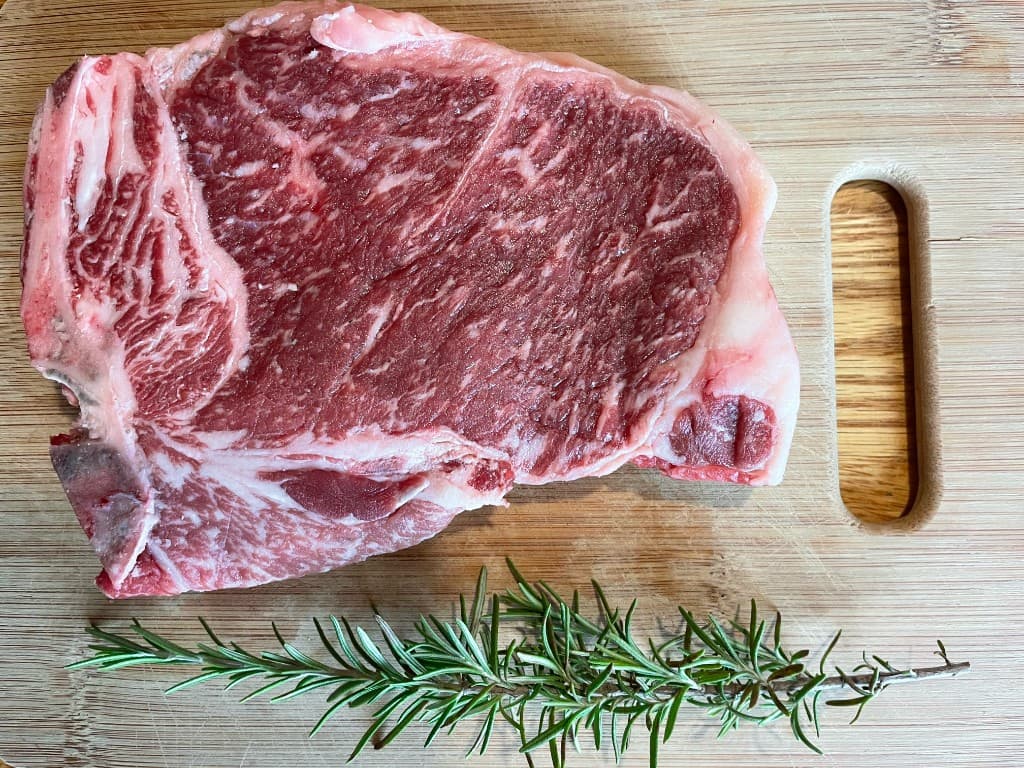
Marbling is deposited over time. Fat inside the muscle is the last thing an animal lays down, well after it has finished growing frame and muscle, so the length of the finish is most of what separates a Wagyu carcass from a Wagyu pedigree. Genetics set the ceiling; days on feed decide how close the animal gets to it.

Commodity beef in the United States is typically finished in a few months. Much of what is sold domestically as Wagyu runs somewhere in the range of 200 to 400 days. FB94946 has had more than 500 consecutive days, which is the reason the marbling claim on the rest of this site is worth making at all — and the reason he costs what he costs to raise.

He has also never carried a growth implant, never had antibiotics in his feed and none routinely, and never been given a beta-agonist. He was born here, has had the same handlers his whole life, and has never been through a feedlot or a sale barn. The full husbandry position, including where we deliberately stopped short of the absolutes competitors use, is on how we raise them.

What a share of him comes to

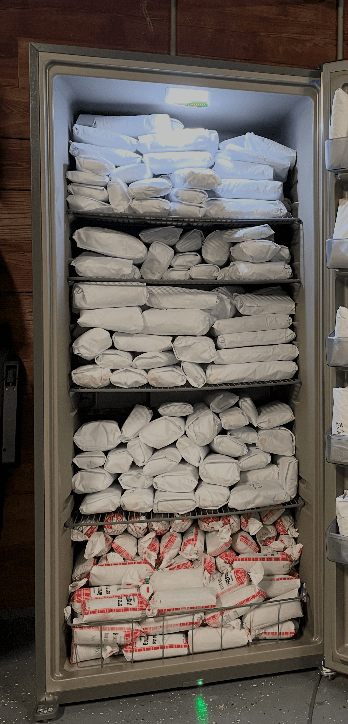
At an estimated 840 lbs hanging, a quarter share is about 147 lbs of packaged beef and a half is about 294 lbs. All in — beef plus processing at cost on a single bill — a quarter runs $2,300$2,350 and a half $4,600$4,700. That works out to about $16 per pound of beef in your freezer.

The invoice itself is still calculated per lb hanging weight against the actual figure the processor reports, because what changes hands is a share of the animal. The per-pound number above is the honest translation of that into the unit people compare.

One carcass with several owners is cut to one specification, so every share of FB94946 comes back as the Ranch Standard Cut:

  • Ground beef, 1 lb packages — about 65 lbs in a quarter, 131 lbs in a half
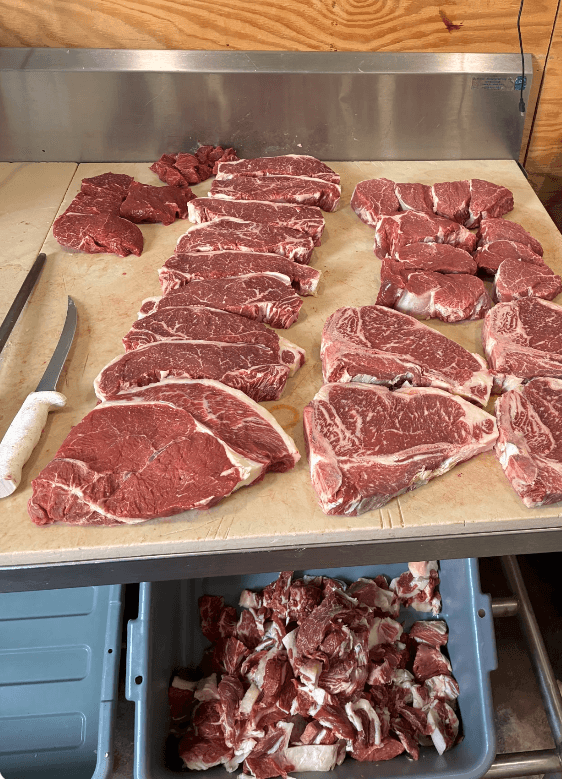
  • Steaks — ribeye, NY strip, sirloin, filet, flank, skirt — about 28 lbs in a quarter, 56 lbs in a half
  • Roasts — chuck, rump, brisket, round — about 42 lbs in a quarter, 84 lbs in a half
  • Short ribs, stew meat, soup and marrow bones — about 12 lbs in a quarter, 23 lbs in a half

Worth noticing how little of that is steak. Most of a share is ground beef and roasts, which is exactly where fullblood marbling earns its keep — the everyday cuts are the ones that change most against what you would otherwise buy.

What this page does not claim

A provenance page is only worth reading if it says what it cannot prove, so here is the other half.

  • No grade. Carcasses processed under the custom-exempt rule are not graded, so FB94946 will have no USDA grade and no Japanese BMS score. Anyone quoting an A5 or a BMS number for beef sold this way is quoting something that was never measured.
  • Not grass-fed. He is pasture-raised and grain-finished. Those are different claims and the finish is the point — see above.
  • Not organic. We hold no organic certification and do not describe the operation as one.
  • No marbling score, yet. Until he is harvested the only honest evidence is the pedigree and the length of the finish. We intend to photograph the cut face of a ribeye at harvest and publish it here, graded or not.

None of the folklore either. No massage, no beer, no music. What produced this animal is Japanese genetics, a very long finish, and a small herd nobody was in a hurry with.